
Why People Ask You to Repeat Yourself, and What Helps

You finish making your point in a client meeting, and the room is with you.
Then someone leans forward. "Sorry, could you say that again?"
You repeat it, a little slower and a little louder. The meeting moves on, and you move with it. Something small stays behind, and it shows up again the next time you speak.

A professional speaking during a small client meeting while colleagues listen.
Why people ask you to repeat yourself, even when your English is strong
Repeat requests usually come more from rhythm than from vocabulary, grammar, or individual sounds.
You already have the words. Your emails land, and your written analysis holds up under scrutiny. The difficulty shows up only when those same ideas have to travel through speech.
The gap sits in how English carries meaning through sound. This is common, and it has nothing to do with how capable you are. Your listener is not judging you. Your listener is working harder than they should to follow you, and the request to repeat is what that effort sounds like.
Individual sounds matter as well. If one keeps catching, you can build the English R sound on its own. Rhythm is the larger lever, since it moves every sentence you speak rather than one word at a time.
What English listeners are actually listening for
English listeners follow meaning by tracking stress. In most sentences, one word rises above the rest.
Coaches hear the same pattern week after week. A fluent speaker gives every word roughly equal weight, and the sentence arrives even and flat. Nothing in it is louder, longer, or higher, so nothing tells the listener what the sentence is about.
The reason is structural, not personal. Mandarin and Cantonese give syllables fairly equal timing, and tone does its work inside the word. English works differently. Some words stretch out, the small connecting words shrink, and one word takes the peak. Many pronunciation researchers describe English as stress-timed and Mandarin and Cantonese as syllable-timed (Jenkins, 2000; Munro and Derwing, 1999).
When every word carries equal weight, your listener has to search the whole sentence for the point. That search costs time the conversation does not have. Then comes the question.
The one change that helps: one peak per sentence
Give every sentence one clear stressed peak, and your listener knows immediately where the meaning sits.
Take a plain sentence: "I want to go to the store." Three words carry most of the meaning: want, go, store. One of them takes the peak, and in a neutral reading it is store. The rest of the sentence steps back to support it.
The peak is not fixed. You choose it, and your listener follows where you put it:
"WE already finished the report." Your team, not theirs.
"We already FINISHED the report." Done, not still in progress.
"We already finished the REPORT." The report, not the slides.
Same words, three meanings. Nothing changed except where your voice rose.
Most fluent speakers already hear this difference. The challenge is producing it when the conversation speeds up.

A speaker emphasizing a word with a small hand movement while talking.
How to practise it in sixty seconds
You can train this with three steps and one hand movement, using a sentence you already say at work.
Choose one real sentence from your week. A line from your status update, your introduction, or your pitch. Real material beats textbook material.
Say it three times, moving the peak each time. Notice how the meaning changes under your voice. That shift is the whole lesson.
Add a small bounce of your hand on the peak word. Keep the rest of your body still, so the movement marks one word only.
That third step is Kinetic Phonetics®, the gesture layer inside The SpeakEasy Method®. Movement mapped to sound sets a pattern faster than listening on its own, which is how gesture and sound train together across the method.
Run it once a day for a week. Try it in a low-stakes meeting before you need it in a high-stakes one.
What changes when your listener stops working
When your rhythm carries the meaning, people respond to your point instead of asking for it twice.
The change is quieter than you expect. You get through your update without the interruption. You reach the second half of your idea, since you no longer spend that space repeating the first half. You stop bracing, halfway through every sentence, for a question that was never about your thinking.
That is the shift clients describe most often. They do not sound like someone else. They sound like themselves, heard the first time.

A professional presenting to a small group of colleagues who are listening attentively.
Where to start
Your accent carries your history and your bilingual intelligence. None of that has to change for you to be understood the first time.
Rhythm responds to training. Other people usually notice the change before you feel it.
If you want to know where your rhythm sits today, start with the free pronunciation diagnostic. You record a short passage, and an AI report shows you where you are right now. No pressure, just a clear picture.
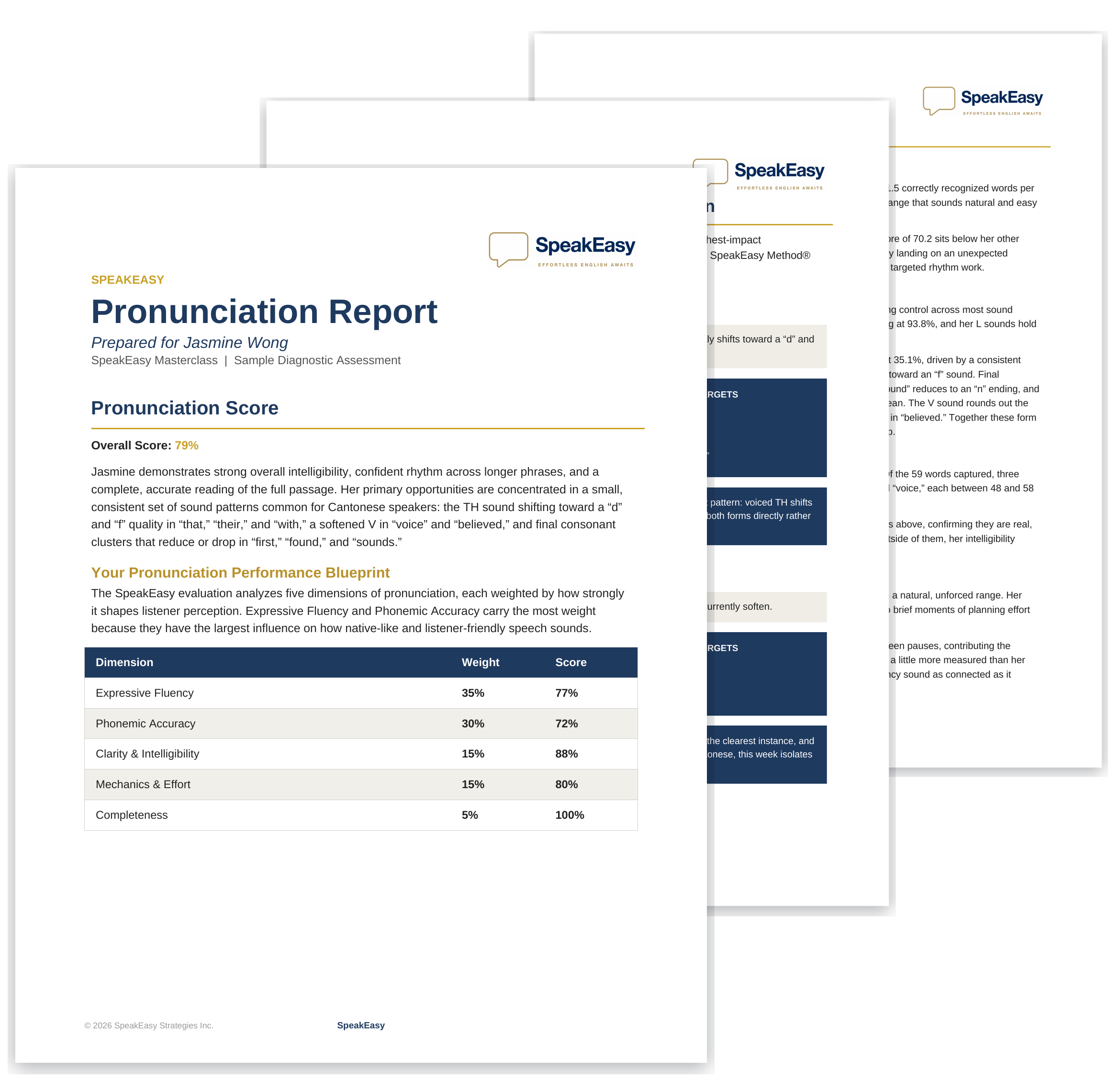
Sample AI Pronunciation Report showing the scored dimensions from a first recording.